You're Doing the Work. Your Underwriter Has No Idea.
Dan Cramer on what underwriters actually look for, what operators fail to communicate, and why documentation is the difference.
Your company may have a solid safety program. Your drivers may be trained. Your leak and pressure checks may be documented. Your policies may be current and actually in use.
Your underwriter may never see any of it.
That’s the problem Dan Cramer runs into again and again with independent propane marketers. Dan is a Commercial Account Executive at First West Insurance in Bozeman, Montana, and a partner of 1075 Consulting. He has spent more than 20 years in insurance with a focus that narrowed over time until propane became the center of it, and is the driving force behind the Propane Safety Summit.
On a recent Drop Point episode, he explained why so many operators are doing the right things and getting no credit for them.
The Underwriter Doesn’t Have a Front-Row Seat
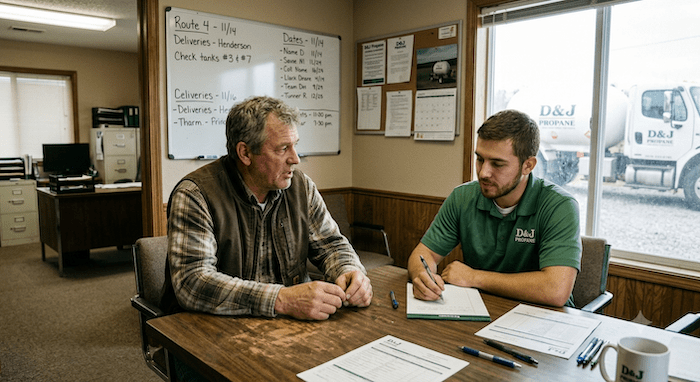
Here’s the piece most operators miss. The underwriter isn’t there when your technician performs the leak check. They aren’t in the office when someone documents a customer conversation. They don’t sit in on the training session.
They see one thing: the information that makes it into the submission.
“A lot of the operators are doing the correct things,” Dan said. “It’s just that it wasn’t disclosed to the underwriter.”
Often the agent submitted exactly what was requested and nothing more. If the underwriter didn’t ask about it, they don’t know it exists. Meanwhile the operator’s full safety program sits in a filing cabinet, invisible to the person setting their rate.
What Underwriters Actually Look For
Dan walked through the documentation that matters, and it’s important to understand why each piece carries weight rather than just checking it off a list.
Duty to warn documentation gives you a record of what was communicated to the customer. After a large loss, the first thing anyone asks is whether warnings were sent. Without that record, the operator looks negligent before the facts are even argued.
Leak and pressure check records show that required checks were performed and, just as importantly, that they were documented.
Written automatic fill agreements and out of gas forms establish what was supposed to happen and what actually happened when a customer ran low.
Training records, including PEP certifications, show that employees were trained and that the training is ongoing rather than a one-time event.
Driver files and defensive driving programs demonstrate that fleet safety is an active program, not just a box checked on an application.
On how much any single item counts, Dan was direct. It isn’t a line-item credit system. Nobody gets a set percentage off for clean driver files. It’s the aggregate. An operation with immaculate driver files and a gap in leak and pressure check documentation can still lose a market entirely, because the underwriter sees the gap, not the strength.
The flip side is the opportunity. When the full picture is strong and it’s actually presented, underwriters start competing for the account. In Dan’s words: “When the underwriters are competing for your business, the operator wins.”
Doing The Work vs Proving The Work
This is the heart of it. Your safety program does nothing for your insurance submission if nobody knows it exists.
Dan’s fix is what he calls providing the receipts, and the best example is one every operator will recognize. The application asks whether you have written accident policies and procedures. Everyone checks yes. Underwriters know everyone checks yes, so the answer carries almost no weight.
So don’t just check the box. Send the actual policies. Now the underwriter has something concrete to put in the file, and when their manager asks why they extended credits on the account, they can open that file and point to the reason.
The pattern applies across the board:
- Don’t just say you have a written policy. Include it.
- Don’t just say employees are trained. Show the training records.
- Don’t just say you have a driver safety program. Show what’s in it.
- Don’t just say you document customer interactions. Be ready to show the process.
- Don’t just say you have procedures. Make sure they’re current and actually being used.
A Quick Word On The Carrier Behind Your Policy
One thing worth knowing: not all carriers are the same. An admitted carrier files its rates and forms with the state, which adds a layer of consumer protection. A non-admitted carrier, also called surplus lines, doesn’t, which gives flexibility when an operation doesn’t fit a standard carrier’s appetite but can also mean exclusions worth reading closely and premium due in full up front. Roughly 40 percent of Dan’s book is non-admitted, so neither is inherently bad. The point is knowing which you have and why. Plenty of admitted carriers run dedicated propane programs, so being in this business doesn’t lock you into one path.
That’s a conversation worth having directly with an agent who knows propane. But it’s separate from the real issue this article is about: admitted or non-admitted, your underwriter still only sees what actually makes it into the submission.
If You Only Change One Thing
Justin asked Dan what he’d have every independent operator do differently if he could pick just one thing. He didn’t hesitate.
Documentation.
Not to satisfy a regulator, but because of what happens after a loss. Written records let you reconstruct what actually occurred: what services were performed, what warnings were given, what procedures were followed when a customer ran out. They give you a factual account when the pressure is on and everyone is pointing at the marketer.
Or as Justin put it: if you didn’t document it, you didn’t do it. You may well have done it. You just can’t prove it in a courtroom.
Give Your Underwriter The Full Picture
Here’s your assignment for this week. Call your agent and ask one question:
“What are you telling the underwriter about our safety program that isn’t on the application?”
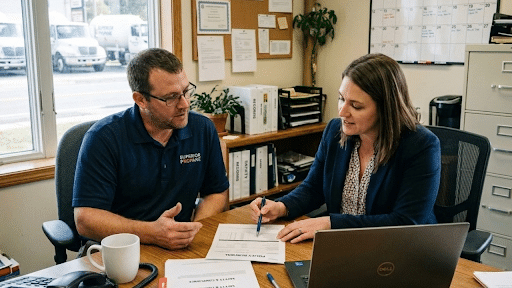
Then ask to see the written plan they share with underwriters. Not the application. Not the quote. The one- to two-page summary that pulls together everything your operation does on safety, compliance, and documentation and puts it in front of the underwriter before they price anything.
If your agent doesn’t have one, that’s your answer.
If you’re doing the work but aren’t sure your agent or underwriter is seeing the full picture, that’s a gap 1075 Consulting can help you close. Brian and Justin work with propane operators to review documentation, safety procedures, and training records, organize what you’re already doing, and make sure it’s presented accurately. Schedule a free discovery call to start with an honest look at what your operation is doing versus what your paperwork actually proves.